




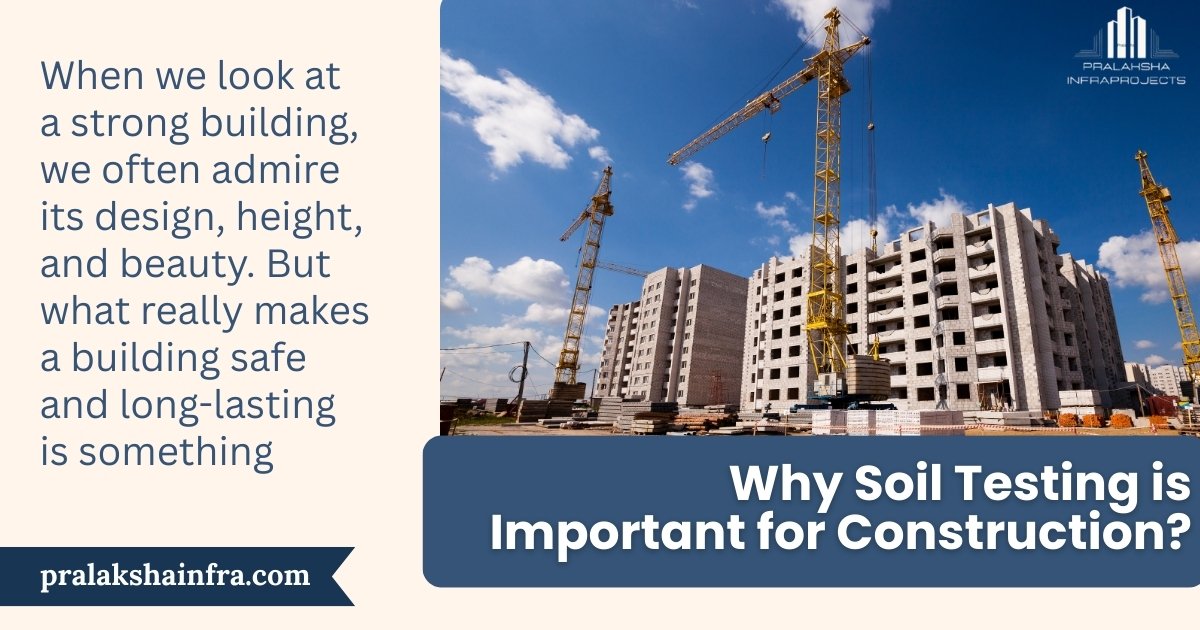
When we look at a strong building, we often admire its design, height, and beauty. But what really makes a building safe and long-lasting is something we cannot see easily—the soil beneath it. No matter how modern or expensive a structure is, if the ground below is weak, the building will eventually face problems. That’s why soil testing is one of the most important steps before starting any construction project.
At Pralaksha Infra, we always believe that a strong structure begins with understanding the ground it stands on. In this article, we’ll explain in simple and clear words why soil testing is important for construction and how it directly affects safety, durability, and overall project success.
What is soil testing?
Soil testing is the process of examining the soil at a construction site to understand its properties. Engineers collect soil samples and analyze them to know:
-
How strong the soil is
-
How much weight it can carry
-
Whether it holds water
-
What type of soil it is
This process is part of a detailed site investigation, and it helps engineers design safe and reliable buildings. Pralaksha Infraprojects provides comprehensive soil testing services as part of its civil engineering and infrastructure solutions.
1. Understanding Soil Stability
One of the main reasons for soil testing is to check soil stability. Not all soil types are suitable for construction. Some soils are strong and compact, while others are loose or soft.
For example:
-
Clay soil can expand and shrink with moisture.
-
Sandy soil may not hold weight properly.
-
Rocky soil is generally more stable.
If soil is unstable, the building may crack, tilt, or even collapse over time. Soil testing helps engineers understand how stable the ground is and what precautions are needed before construction begins.
2. Proper Foundation Design
Every building needs a strong base. The Foundation Design depends completely on the type of soil at the site.
There are different types of foundations:
-
Shallow foundations
-
Deep foundations
-
Pile foundations
The choice depends on the soil condition. If the soil is weak near the surface, engineers may design a deeper foundation. If it is strong, a shallow foundation may be enough.
Without soil testing, foundation design becomes guesswork — and guesswork in construction is risky and expensive.
At Pralaksha Infra, we ensure proper testing before finalizing any foundation design to avoid future problems.
3. Checking Load-Bearing Capacity
Every structure puts weight on the ground. This weight includes:
-
Building materials
-
Furniture
-
Equipment
-
People
The soil must be able to support all this weight. This ability is called Load-Bearing Capacity.
If the soil cannot carry the load:
-
The building may sink.
-
Cracks may appear in walls.
-
Floors may become uneven.
Soil testing helps determine the safe load-bearing capacity of the soil so engineers can design the structure accordingly.
4. Understanding Soil Composition
Different construction sites have different soil testing compositions. Soil can be:
-
Clay
-
Sand
-
Silt
-
Gravel
-
Rock
Each type behaves differently under pressure and moisture. For example:
-
Clay holds water and expands.
-
Sand drains water quickly.
-
Gravel provides good drainage and strength.
Knowing the soil composition helps in selecting the right construction methods and materials. It also helps avoid surprises during excavation.
5. Knowing the Groundwater Level
The Groundwater Level plays a very important role in construction.
If groundwater is too high:
-
Basements may face water seepage.
-
Foundations may weaken.
-
Steel reinforcement may corrode.
Soil testing helps determine the depth of groundwater and whether waterproofing or drainage systems are needed.
Ignoring groundwater conditions can lead to major long-term damage.
6. Ensuring Structural Safety
The ultimate goal of soil testing is Structural Safety. A building must protect the people inside it.
Weak soil can lead to:
-
Uneven settlement
-
Cracks in beams and columns
-
Structural imbalance
In extreme cases, poor soil conditions can lead to building failure.
By conducting proper soil tests, engineers can design structures that remain safe for decades. At Pralaksha Infra, safety is always our first priority.
7. Settlement Prevention
One common issue in construction is settlement. Settlement happens when soil compresses under the building’s weight.
If settlement is uneven:
-
Walls may crack.
-
Doors and windows may not close properly.
-
Floors may slope.
Through soil testing, engineers can predict possible settlement and take preventive measures. This helps in Settlement Prevention and ensures long-term stability.
8. Importance of Compaction Testing
Before construction, soil is often compacted to increase its strength. Compaction Testing checks whether the soil has been compressed properly.
Proper compaction:
-
Reduces air gaps in soil
-
Increases load-bearing capacity
-
Prevents future settlement
Without compaction testing, loose soil can cause major structural issues later.
This small step during site preparation can save huge repair costs in the future.
9. Improving Construction Durability
A building is not meant to last just a few years — it should stand strong for decades. Soil testing directly impacts Construction Durability.
When soil conditions are understood properly:
-
The right foundation is selected.
-
Drainage systems are planned correctly.
-
Moisture problems are avoided.
All these factors increase the life of the structure.
A durable building is not only safe but also cost-effective in the long run.
10. Role of Site Investigation
Soil testing is a major part of Site Investigation. Site investigation includes:
-
Soil sampling
-
Borehole drilling
-
Laboratory testing
-
Field tests
This detailed study provides complete information about the ground condition.
Without proper site investigation:
-
Construction risks increase.
-
Unexpected expenses arise.
-
Project delays become common.
At Pralaksha Infra, we believe a proper site investigation is the foundation of successful construction.
What Happens If Soil Testing Is Ignored?
Skipping soil testing might save some money at the beginning, but it can cause serious problems later, such as:
-
Foundation cracks
-
Water leakage
-
Structural damage
-
Expensive repairs
-
Legal liabilities
In worst cases, buildings may become unsafe for use.
Soil testing is not an expense — it is an investment in safety and stability.
How Soil Testing Saves Money
Many people think soil testing increases project cost. In reality, it helps save money by:
-
Avoiding overdesign (extra concrete and steel)
-
Preventing structural repairs
-
Reducing project delays
-
Ensuring proper material use
When soil conditions are known, engineers can design efficiently without unnecessary costs.
Real-Life Example
Imagine constructing a residential building on soft clay soil without testing. After a few years:
-
The building starts sinking slightly.
-
Cracks appear in walls.
-
Water enters the basement.
Now, repairs will cost much more than the initial soil testing cost.
This is why professional companies like Pralaksha Infra never skip soil testing before starting any project.
Frequently Asked Questions (FAQ)
1. What is soil testing in construction?
Soil testing is the process of analyzing soil properties at a construction site to determine its strength, composition, load-bearing capacity, and groundwater conditions.
2. Why is soil stability important?
Soil stability ensures that the ground can safely support the structure without shifting, sinking, or cracking over time.
3. How does soil testing affect foundation design?
Soil testing helps engineers choose the correct type and depth of foundation based on soil strength and condition.
4. What is load-bearing capacity?
Load-bearing capacity is the maximum weight that soil can safely support without failure or excessive settlement.
5. Can soil testing prevent cracks in buildings?
Yes. By understanding soil behavior and settlement risk, engineers can design foundations that reduce the chances of cracks.
6. Is soil testing required for small houses?
Yes. Even small residential buildings need soil testing to ensure safety and durability.
7. How long does soil testing take?
It depends on the site size and project type, but usually it takes a few days to a couple of weeks.
8. Does groundwater level affect construction?
Yes. High groundwater can weaken foundations and cause water seepage issues if not properly managed.
9. What is compaction testing?
Compaction testing checks whether soil has been properly compressed to increase its strength and stability.
10. Is soil testing expensive?
Compared to the total construction cost, soil testing is affordable and prevents costly repairs in the future.
Conclusion
Soil testing is one of the most important steps in any construction project. It helps engineers understand soil stability, foundation design requirements, load-bearing capacity, soil composition, groundwater level, and many other critical factors.
Without proper soil testing and site investigation, construction becomes risky and unpredictable. It can lead to structural damage, safety hazards, and financial losses.
At Pralaksha Infra, we strongly believe that every strong building begins with strong ground knowledge. Proper soil testing ensures structural safety, settlement prevention, construction durability, and long-term peace of mind.
In simple words — if you want your building to stand strong for years, never ignore the soil beneath it.
Because the strength of any structure depends not only on what you build — but where and how you build it.
Leave a Reply